Country, Culture, People, Future

Posts By: Yamatji Marlpa Aboriginal Corporation

NAIDOC profile: Wula Guda Nyinda Aboriginal Cultural Tours

Posted: July 7th, 2011

Filed under: , , , , ,

Darren “Capes” Capewell teaching stories of his
country to YMAC staff

Wula Guda Nyinda Aboriginal Cultural Tours is an Indigenous tourism provider in the world heritage listed Shark Bay area. Owner and operator Darren “Capes” Capewell offers tourists a unique insight into the culture and country of the Indigenous people of Shark Bay.

A descendant of the Malgana and Nanda people, Capes is passionate about increasing understanding of and respect for Aboriginal culture.

He does this by offering a variety of tours that include bushwalking, kayaking, collecting bush tucker, and telling stories about the country and its first peoples. “I make all my tours interactive, so people participate in the experience,” he said.

Wula Guda Nyinda translates to “you come this way,” which refers to sharing stories, both between generations and between cultures. Capes sums up this approach with the philosophy of education, understanding and respect, which he stresses throughout his tours.

“I try to challenge negative stereotypes people have of modern Aboriginal people by presenting Aboriginal culture in a positive way. I want people to understand the culture and the country,” Capes said.

Capes works to advance the Indigenous tourism industry through his leadership in the Western Australian Indigenous Tourism Operators Committee, the Shark Bay World Heritage Committee and Indigenous Tourism Australia.

“I think education and awareness of Aboriginal culture is so important, for Aboriginal kids, and for non-Aboriginal people. NAIDOC week is a great thing, because it is a time all Australians can walk together, and learn together, about something that is very unique. We have the oldest living culture in the world, and that is something all Australians should be proud of.”

To learn more visit http://www.wulaguda.com.au/

Across Australia every July, NAIDOC Week celebrates the history, culture and achievements of Aboriginal and Torres Strait Islander peoples. In honour of NAIDOC 2011 YMAC is featuring a series of Aboriginal people and organisations that contribute to the vibrant Aboriginal culture of the Midwest and Pilbara. For more information on NAIDOC including its history and events happening near you, visit http://www.naidoc.org.au/.

NAIDOC profile: Michael Leslie Foundation for the Performing Arts

Posted: July 6th, 2011

Filed under: , ,

Eugene Lyndon, a Michael Leslie student, before his trip to Los Angeles. (Photo courtesy of The Michael Leslie Foundation for the Performing Arts.)

Since its beginnings in 2006, the Michael Leslie Foundation for the Performing Arts has been empowering children in the Pilbara to reach their potential through the performing arts. The many programs run by the foundation all share a common goal of helping people gain self confidence and overcome self-defeating attitudes.

Choreographer Michael Leslie is passionate about changing the lives of young people in the Pilbara. “Performing arts is the way to inspire confidence,” said Michael. “Children need to be taught that they are beautiful, that they are unique. Performing arts is a way for kids to express themselves, and get that confidence… Aboriginal people are cultural people. Singing, acting, dancing- it’s all storytelling. It’s a part of us.”

Michael is motivated by past injustices to Indigenous Australians and a desire to help Indigenous kids become leaders. “Kids need to be supported… I can relate to them because I went through all the same things in my childhood that they are going through now. I set up the foundation to give Aboriginal kids the advantage I had,” said Michael.

The foundation has many different facets, including after school programs, creative writing and adult literacy, workshops, mentoring, and international leadership programs. Currently Michael visits schools throughout the Pilbara to teach performing arts, bringing with him singers, actors and playwrights as guest teachers. The students then visit other schools to perform. He is working on setting up a regional school choir next term.

Through strong corporate partnerships he also supports students to travel internationally to participate in dance and leadership events. Earlier this year he went with three young Pilbara dancers, Treya Long and Kiefer and Eugene Lyndon, to the 23rd Annual International Association of Blacks in Dance conference in Los Angeles, California.

“I try to expose the students to new experiences and open their eyes to the world. It isn’t just about dance, it’s about leadership. Aboriginal people need strong, innovative, savvy leaders. That will make Australia a better country for everyone.”

To learn more visit http://www.michaelleslie.com.au/


Across Australia every July, NAIDOC Week celebrates the history, culture and achievements of Aboriginal and Torres Strait Islander peoples. In honour of NAIDOC 2011 YMAC is featuring a series of Aboriginal people and organisations that contribute to the vibrant Aboriginal culture of the Midwest and Pilbara. For more information on NAIDOC including its history and events happening near you, visit http://www.naidoc.org.au/.

NAIDOC profile: The Bartlett Brothers

Posted: July 5th, 2011

Filed under: , , ,


The Bartlett Brothers is an Indigenous rock band made up of sing-songwriter multi instrumentalists Phil and Jason Bartlett, their younger brother Azrael on drums and bassist Rob Findlay. They describe their music as “soulful rootsy pop rock sounds with soaring harmonies”, and they draw imagery and inspiration from their country and heritage.

Set to be stars of NAIDOC in WA this year, the band is appearing at NAIDOC festivals in Perth and Karratha. “NAIDOC is important for everyone, not just indigenous people,” said Phil Bartlett. “It gives everyone a chance to feel indigenous culture.”

The Bartlett Brothers are no strangers to travelling up to the Pilbara. Although their family’s roots are in the Midwest and the Southwest regions of WA, the brothers went to schools in the Pilbara and the Kimberley. They have had plenty of chances to go back and visit, as the hard-working band has been playing gigs and touring for many years.

“What I’m most proud of is how hard we’ve worked. We’re now becoming recognised and well known, and it’s all through hard work. We’ve been doing this for fifteen years, it didn’t just happen,” said Phil.

The band is gaining plenty of recognition, as their list of awards keeps growing. They have received awards from the Too Solid Awards, WA Music Industry, NAIDOC, and Next Best Thing, and Jason made it to the top 24 of Australian Idol.

Phil says that the band draws inspiration from Indigenous musicians that came before them, like Archie Roach, who will also be performing at the Karratha NAIDOC community festival. “To be playing with Archie Roach is fantastic. Back when he started out it was pretty hard for Aboriginal musicians, but people like him set the way for us,” said Phil. “Indigenous music is getting bigger and bigger. There are more pathways, more money, more opportunities for Indigenous artists, and more and more of us are touring, recording albums, and putting up websites. It’s only a matter of time before the next big Aboriginal act becomes a household name.”

You can see the Bartlett Brothers at the Perth NAIDOC ball on Friday, 8 July and at the Karratha NAIDOC closing community festival on Sunday, 10 July.

Across Australia every July, NAIDOC Week celebrates the history, culture and achievements of Aboriginal and Torres Strait Islander peoples. In honour of NAIDOC 2011 YMAC is featuring a series of Aboriginal people and organisations that contribute to the vibrant Aboriginal culture of the Midwest and Pilbara. For more information on NAIDOC including its history and events happening near you, visit http://www.naidoc.org.au/.  
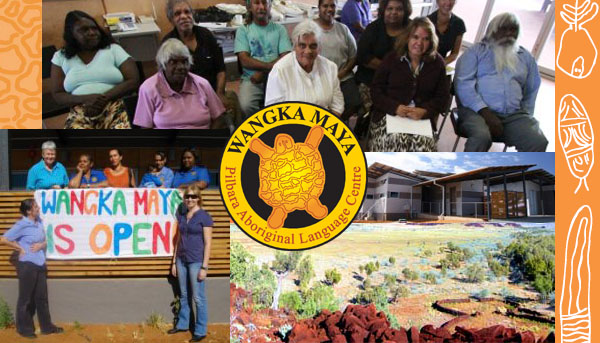
NAIDOC profile: Wangka Maya Pilbara Aboriginal Language Centre

Posted: July 4th, 2011

Filed under: , ,

Wangka Maya Pilbara Aboriginal Language Centre is a language centre in South Hedland dedicated to preserving and teaching Indigenous languages of the Pilbara region. It began in 1987 when a group of Aboriginal people started recording languages that they feared were in danger of being forgotten. From its modest beginnings it has grown into a vibrant organisation with a wide range of projects and an impressive workload.

Wangka Maya’s work is driven by the urgency to record languages with few speakers before they are lost forever. “Wangka Maya’s work is very important … recording and documenting 31 languages, some with only a handful of speakers left. We have to have it on record, or else the language will be totally lost. If there are no more speakers left, how will the younger generations know how it sounds?” said Harry Taylor, current treasurer of Wangka Maya.

This sense of urgency has led Wangka Maya to prioritise languages with the fewest remaining speakers, producing wordlists and dictionaries, followed by sketch grammars which describe the use and structure of the language, and over the years, more books and resources for children.

Beyond language, Wangka Maya also records information and produces resources in the areas of history and culture, provides cultural awareness training and participates in a range of community partnerships and initiatives to promote understanding of and interest in Aboriginal language, culture and history. Wangka Maya also reconnects Pilbara and Gascoyne Aboriginal people to their families who have lost contact due to government action or other issues through the Link Up program.

Anne Sibosado, long time board member of Wangka Maya, feels a personal connection with the work of the language centre. “Growing up I wasn’t allowed to speak language in school, but it’s important to your identity. Being involved [with Wangka Maya] has helped me get my identity back… I hope the younger people will come to use [Wangka Maya’s resources], because they are our future. We want more young people to come aboard,” said Anne.

Harry Taylor believes that, “the wider Australian community is recognising language diversity more and accepting it more,” and Australia is a richer place for that.

Wangka Maya is offering a free cultural awareness training course on 7 July for NAIDOC week. For more information please visit www.wangkamaya.org.au or call 9172 2344.

Across Australia every July, NAIDOC Week celebrates the history, culture and achievements of Aboriginal and Torres Strait Islander peoples. In honour of NAIDOC 2011 YMAC is featuring a series of Aboriginal people and organisations that contribute to the vibrant Aboriginal culture of the Midwest and Pilbara. For more information on NAIDOC including its history and events happening near you, visit http://www.naidoc.org.au/ .

NIADOC profile: Yamaji Art

Posted: July 3rd, 2011

Filed under: , , ,

Yamaji Art is an Aboriginal owned and governed art centre in Geraldton, Western Australia which has been described as “the artistic voice of the Midwest”. It represents Aboriginal artists from many of the region’s towns and beyond, including Geraldton, Mullewa, Yalgoo, Meekatharra, Cue, Mt. Magnet, Carnarvon and even Port Hedland. Yamaji Art was founded two years ago as a business arm of Marra Indigenous Art and Design.

Yamaji Art supports its artists by providing materials, running workshops, and generally encouraging quality art by providing a safe space for creative expression. They help artists become self sufficient by connecting them with buyers locally, nationally and internationally.

Despite its relative youth as an organisation, Yamaji Art has had successful shows in Perth, Cairns, and Capetown, and is scheduled to have a show in Washington DC this October.

“My paintings help me. When I get stressed or angry I just go paint and it really helps me. When I finish a painting I take it to Yamaji Art and they decide where to put it so people will see it,” said Olive Boddington, one of the artists with Yamaji Art.
Olive participated in a program run by Yamaji Art with Curtin University and the International Centre for Radio Astronomy Research called Ilgarijiri. Several artists went out to Boolardy Station, the site of the ASKAP radio telescope, and drew inspiration from the landscape and the sky while learning about radio astronomy.

“I was born out in the bush, on Yallalong Station, so the trip was like going home for me. I paint what I know from that area in the Murchison, so the trip was very inspirational,” Olive Boddington said.

As a place where art and traditional culture meet, the collective serves as a place to house stories, foster creative development and skills, and bring artists of the Midwest into the Aboriginal art movement.

Yamaji Art is exhibiting at the Arts and Cultural Development Council (ACDC) in Geraldton as part of their NAIDOC show. The exhibition runs 8-29 July. Yamaji Arts will also be running bush basket weaving workshops on Tuesday, 5 July and Wednesday, 6 July at the ACDC. To learn more call 9965 3440.

Across Australia every July, NAIDOC Week celebrates the history, culture and achievements of Aboriginal and Torres Strait Islander peoples. In honour of NAIDOC 2011 YMAC is featuring a series of Aboriginal people and organisations that contribute to the vibrant Aboriginal culture of the Midwest and Pilbara. For more information on NAIDOC including its history and events happening near you, visit http://www.naidoc.org.au/.
Apply now for Community Action Grants

Posted: June 29th, 2011

Filed under: ,

Through the Australian Government’s Caring for our Country initiative, Community groups around Australia can now apply for small grants to help fund local environmental and sustainable agriculture projects. The 2011-12 Community Action Grants round will make $5 million dollars available to rural, urban and Indigenous community groups to help them conserve and protect their local environment and natural resources.

The grants will range from $5000 to $20,000 for projects such as planting trees, revegetating landscapes, rehabilitating dunes, removing weeds, controlling pests, holding field days, recording traditional ecological knowledge and improving sustainable land management practices.

These grants will enable community groups and local Indigenous organisations to look after their country through programs that protect biodiversity and natural icons, coastal environments and critical aquatic habitats.

Applications for the 2011-12 Community Action Grants will close Monday 1 August 2011. More information on Caring for our Country and Community Action Grants, including how to apply, is available at http://www.nrm.gov.au/ or by calling 1800 552 008.

Check out issue 14 of YMAC News

Posted: June 24th, 2011

Filed under: , , , , , , , , ,

The latest issue of YMAC News is out today, filled with information about the great work being done by traditional owners and YMAC staff. Issue14 of our newsletter focuses on the land access deals struck between four native title groups and Rio Tinto Iron Ore, with sections on each group and what the agreements will mean for them.

There are stories about  our co-chair of the Board talking about carbon farming in Canberra, the realease of YMAC’s community guide, the substantial role played by YMAC at the annual National Native Title Conference, as well as profiles of some of our board members.

We hope you enjoy the 14th issue of YMAC News.
Click the link below for an electronic version or email srosenfeld@ymac.org.au to request hard copies for yourself, your family, your business or workplace.

YMAC News issue 14

Badimia protects Lake Moore

Posted: June 23rd, 2011

Filed under: , ,

Yesterday the National Native Title Tribunal handed down a decision that will help the Badimia people look after Lake Moore and the many places around it that are important to the Badimia people.

Lake Moore, a dry salt lake south of Paynes Find, is a very special place for Badimia people. Many Badimia people visit the area with their families every year to go camping, hunting, collecting bush medicines and teaching the younger generations about country and culture. Lake Moore and the surrounding area is not only important as a place for Badimia families to go out on country, but it is home to very sacred places where ceremonies traditionally took place.

The National Native Title Tribunal recognised how important this place is for the Badimia people by ruling that the company seeking a mineral exploration licence has to negotiate with the Badimia people before it can have access to the area for low-impact exploration activities. This will allow the Badimia people to have more of a say over access to the area, and will give them a chance to make sure the mineral explorers have an understanding of the significance of the area. 

3-10 July is NAIDOC Week

Posted: June 20th, 2011

Filed under: , ,

NAIDOC Week, an annual celebration of the history, culture and achievements of Aboriginal and Torres Strait Islander peoples, is fast approaching. NAIDOC is a time for both Indigenous and non-Indigenous Australians to celebrate.  The week is a great opportunity to participate in a range of activities and to support your local Aboriginal and Torres Strait Islander community.

NAIDOC originally stood for ‘National Aborigines and Islanders Day Observance Committee’. This committee was once responsible for organising national activities during NAIDOC Week and its acronym has since become the name of the week itself.

There are a number of community celebrations in the MidWest and Pilbara, including NAIDOC Idol in Karratha, A family day in Geraldton, a community concert in Port Hedland, and a film festival in Carnarvon, to name just a few.

To find out about NAIDOC Week activities in your area, contact your nearest Indigenous Coordination Centre (ICC) on free call 1800 079 098. There are ICC offices in South Hedland, Geraldton, Perth, and many other locations nationally.

Country is our mother, the provider and keeper of cultural belongings. Country and Culture go together. You can’t have one without the other.

Yamatji Marlpa Aboriginal Corporation respectfully acknowledges the Traditional Owners and custodians throughout Western Australia, and on whose Country we work. We acknowledge and respect their deep connection to their lands and waterways.

We honour and pay respect to Elders, and to their ancestors who survived and cared for Country.

Our offices are located on Whadjuk Country, Southern Yamatji Country, Kariyarra Country, and Yawuru Country. We recognise the continuing culture, traditions, stories and living cultures on these lands and commit to building a brighter future together.

Disclaimer: Caution: Please be advised that this website may contain images, voices and names of deceased people.

This will close in 15 seconds