Country, Culture, People, Future

Blog

Free carbon farming workshops and webinars

Posted: February 5th, 2026

The ABC Foundation (Aboriginal Biodiversity Conservation Foundation) aims to support First Nations people, communities, and organisations in WA to engage in carbon farming, land restoration, and related initiatives, while also preserving cultural heritage.

They are currently offering a range of free online live workshops and pre-recorded webinars for people interested in learning more about carbon farming. The workshops will run from 11.am-1.30pm, with the webinars starting at 11am running for either 30-60 minutes.

You can also watch this informative video on Carbon Farming for First Nations land owners on YouTube.

The current schedule and topics include:

  • Wednesday, 11 February: Carbon Farming Workshop
  • Tuesday, 17 February: An Introduction to Nature Repair Webinar
  • Wednesday, 4 March: Climate Change and its Impacts on Country Webinar
  • Wednesday, 11 March: Carbon Farming Workshop
  • Tuesday, 17 March: Blue Carbon – What is it? Webinar
  • Wednesday, 8 April: Carbon Farming Workshop
  • Tuesday, 14 April: Traditional Ecological Knowledge (TEK), Fire Management and Cultural Burning Webinar
  • Tuesday, 21 April: Soil Carbon – The Science Behind it Webinar
  • Tuesday, 5 May: Natural Capital and Accounting Webinar
  • Wednesday, 13 May: Carbon Farming Workshop
  • Tuesday, 19 May: Indigenous Rights and Free, Prior, and Informed Consent Webinar
  • Wednesday, 3 June: Carbon Project Setup and Operations Webinar
  • Wednesday, 10 June: Carbon Farming Workshop.

Everyone is welcome to attend these free sessions to explore what carbon farming can mean for land and community. Find out more and register on the ABC Foundation website.

Help shape DMPE’s Aboriginal Cultural Capability Strategy

Posted: February 4th, 2026

The WA Department of Mines, Petroleum and Exploration (DMPE) is developing an Aboriginal Cultural Capability Strategy and is seeking insight to help shape its direction.

DMPE is hosting meetings, facilitated by Garlett Group, aiming to provide an opportunity for you to have a say and contribute directly to the strategy. Meetings will be held in:

  • Perth: Thursday, 12 February 2026
  • Kalgoorlie: Thursday, 19 and Friday, 20 February 2026
  • Karratha: Thursday, 26 February 2026
  • Port Hedland: Friday, 27 February 2026.

If you are unable to meet on these dates, you are also invited to complete the registration form outlining that you would like to meet during the consultation period.

Register online now.

NAIDOC 2026: 50 Years of Deadly

Posted: February 4th, 2026

This year’s National NAIDOC Week theme has been announced, marking a major milestone.

The theme, ‘50 Years of Deadly’, honours all those who have helped to build the NAICOC movement over the last 50 years. It looks to the past, while recognising how far we’ve come, where we’re at today, and where we are headed over the next 50 years and beyond.

In celebrating this year’s theme, the annual National NAIDOC Poster Competition is now open! The competition invites First Nations people from across Australia to submit an artwork reflecting the theme, which will then be used as this year’s NAIDOC poster throughout NAIDOC Week (5–12 July 2026). Entries close at 8.59pm AWST on Sunday, 1 March 2026, and can be submitted via the National NAIDOC website.

The National NAIDOC Awards have also opened for nominations, celebrating Aboriginal and Torres Strait Islander people who are making a difference. We would love to see people within our regions recognised for their amazing contributions to their communities. Nominations close at 8.59 AWST on Sunday, 8 March 2026, and you can submit your nominations on the NAIDOC Awards Platform.

National NAIDOC have also announced the opening of this year’s NAIDOC Local Grants. The grants are available to support NAIDOC celebrations across Australia. Grants are available in the following streams:

  • Educational institutions (up to $1,500)
  • Small scale grants (up to $10,000)
  • Large scale grants (between $10,00 and $25,000).

Applications for NAIDOC Local Grants closes at 12noon AWST on Thursday, 19 February 2026, and must be submitted via Grant Connect.


Message from the National Indigenous Australians Agency on recognition of Native Title Representative Bodies

Posted: February 4th, 2026

The Minister for Indigenous Australians, Senator the Hon Malarndirri McCarthy, has invited Cape York Land Council (CYLC), Kimberley Land Council (KLC), North Queensland Land Council (NQLC) and Yamatji Marlpa Aboriginal Corporation (YMAC) to apply for further terms as the native title representative bodies for their regions. KLC, NQLC and YMAC’s current terms as representative bodies end on 30 June 2026. CYLC’s current term as a representative body ends on 31 December 2026.

People with native title interests in the regions covered by these organisations, and Aboriginal and Torres Strait Islander people living in those regions, can make a submission about the relevant organisation to inform the Minister’s decision.

Making a submission – Submissions are due by 5.00 pm AEDT on 2 March 2026.

Further information, including how to make a submission, what information to include, and how submissions will be managed can be found on the NIAA website at: Recognition of Native Title Representative Bodies | NIAA

Board Governance Prescribed Body Corporate and Indigenous Community Organisation Scholarship Program

Posted: January 22nd, 2026

The Australian Institute of Company Directors (AICD) has partnered with BHP to offer a scholarship program for First Nations leaders and Board Directors, designed to build strong governance skills, support community decision-making and prepare future leaders for potential board roles.

The next round of the program will be held in WA between February to May 2026.

The scholarship includes:

  • AICD’s Governance Foundations for Not-for-Profit Directors, a 1.5 day course, delivered face-to-face in Perth.
  • A half-day leadership workshop delivered by JY Australia, focussed on community and cultural values, to ensure scholars can contribute to collective decision-making in a way that respects traditional leadership structures.
  • Reimbursement of reasonable travel costs to attend the course delivery, including 2 nights’ accommodation and meal allowance.
  • Virtual coaching sessions focussed on: Values, The Board and CEO Relationship, Strategic Planning for the New Year, and End-of-Year Financials and Reporting (four sessions in total) led by Jahna Cedar OAM GAICD.
  • Invitation to attend AICD’s First Nations Community of Practice sessions – which provide an invaluable space for First Nations leaders to connect, share experiences, and strengthen their governance capabilities together, drawing on both traditional and contemporary knowledge.

Applications are now open, closing on Wednesday, 28 January 2026. If you are interested in applying but are concerned about the timing of this deadline, email the AICD Scholarships Team at scholarships@aicd.com.au.Find out more and apply on the AICD Scholarships platform.

Traditional Owners contribute to development of YMAC’s upcoming TEK survey guidelines

Posted: December 15th, 2025

YMAC’s Land and Sea Management (LSM) team, in collaboration with Pilbara ethnobotanist Vicki Long & Associates (VLA), has been working on the development of Traditional Ecological Knowledge (TEK) survey technical guidance.

The project aims to provide clarity and improve both the consistency and quality in TEK reports being produced. When published, the guidance will act as a standard framework for the design and scoping of TEK surveys in the context of the Environmental Protection Authority’s Social Surroundings requirement during the Environmental Impact Assessment process.

Social Surroundings surveys in the context of Aboriginal communities usually entail the assessment of First Nations values and concepts, such as the notion of Country, bush tucker, bush medicine, mythological features of the landscape, water flows, or song lines. These surveys require specific expertise to capture information related to ethno-botany and other traditional ecological knowledge (TEK).

Through producing guidelines for the design and scoping of Traditional Ecological Knowledge surveys, YMAC is aiming to address the existing disconnect between First Nations values and priorities and the requirements of the environmental approvals process (typically based on western science).

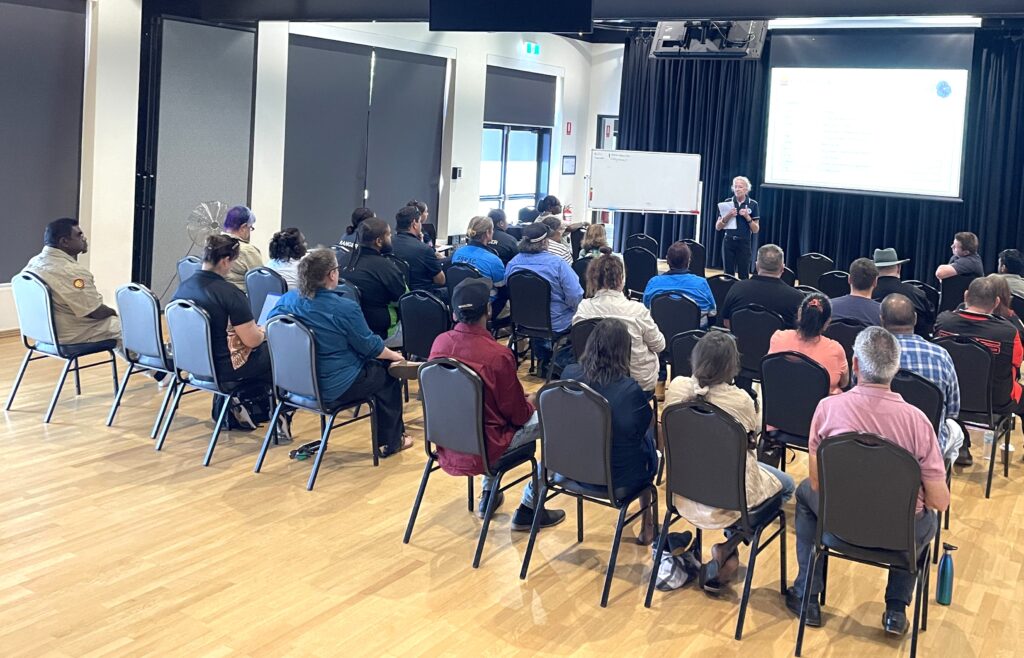
Because we believe it important the process to capture the cultural knowledge to inform the guidelines comes from a grassroots approach and considers cultural protocols, YMAC’s LSM team recently organised a workshop in Karratha. Traditional Owners from 10 different Pilbara groups joined us, sharing valuable insights, raising key questions, and helping to identify essential inclusions for the guidelines.

YMAC thanks all the workshop participants for sharing their knowledge. Outcomes include promoting the adoption of a methodology respecting the principles and values of First Nations communities during the environmental assessment process, while fostering improved engagement between industry proponents and Aboriginal communities impacted by project developments.

The guidelines are currently being developed, with an aim to be finalised in 2026.

This project is supported by funding from the Western Australian Government’s State NRM Program.  Find out more about the NRM program at  https://bit.ly/StateNRM


Public comment invited on the Ghost Bat Recovery Plan

Posted: December 15th, 2025

The Department of Climate Change, Energy, the Environment and Water (DCCEEW) are inviting public comment on their newly released a Ghost Bat Recovery Plan.

The Recovery Plan aims to increase the national population size of the Ghost Bat by 10% by 2041, with the Pilbara one of six regions identified as a region of interest. It includes actions for research and management which aim to stop the decline in numbers of the species, as well as clarifying the distribution, ecology, threats and recovery actions which are necessary and achievable.

Responses to the plan are invited until Tuesday, 10 March 2026. Download the Recovery Plan and submit your responses on the DCCEEW website.

Stolen Generations Redress Scheme

Posted: November 6th, 2025

The WA Stolen Generations Redress Scheme has opened.

First Nations people who were removed from their families in Western Australia before 1 July 1972, while under the age of 18, are eligible to apply for an individual payment of $85,000 through the Stolen Generations Redress Scheme. Payments are expected to be delivered in late 2025.

Find out more and apply on the WA Government website, and/or download the related fact sheet.

Keep mob safe online

Posted: October 29th, 2025

Cyber Security Awareness Month is a great reminder to check our online safety. Though we hear about lots of scammers and dangers of being online, there are some simple things we can do to keep ourselves and our mob safe.

The top three tips for staying safe online are:

  1. Always set up multifactor authentication
  2. Use a unique and strong passphrase, instead of a password, on every account
  3. Install software updates to keep your devices secure.

The Australian Government has released a range of shareable resources to encourage safety, including videos, social media tiles, a poster and a fact sheet. Issues covered include the above three tips, as well as watching out for scams, knowing the dangers of public Wi-Fi, speaking up about cyber-attacks and hacks, and checking privacy and location settings.

Download the resources to be informed and share them amongst your community from the Act Now, Stay Secure website.
